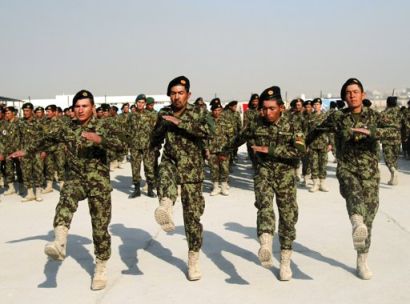
Noncommissioned
officers in the Afghan Army: Are they ready for
U.S.
and NATO forces to leave?
The Frontier Post, Pakistan
Pakistan Has Much to Fear from 'Vietnamization' of Afghanistan
"This
spat between U.S. intelligence agencies and American generals is reminiscent of
the Vietnam War, when the CIA said defeat was inevitable and imminent, while
the generals were adamant that they were winning. … It is not unlikely that for
losing this war, U.S. generals will make Pakistan into a contemporary equivalent
of Cambodia or Laos. The Islamabad establishment had better ponder this and be
prepared for any eventuality."
A classified joint assessment
by the CIA and fifteen other U.S. spy agencies on the Afghanistan War, which
has plunged American spooks and generals alike into a squabble, carries great implications
for Pakistan. Official Islamabad had better take time off of their own
imbroglio to carefully weigh the contents of the report and be prepared to cope
with any eventuality. Judging by leaks in the media, the report paints a very
gloomy picture of the war and contends it has grounded to a stalemate.
Questioning the optimistic assertions of the generals, the report underlines that
any successes they cite are at best tenuous. It even admits that while the Taliban
may have suffered badly in the south, they are not only in the ascendancy in
the east - they have yet to lose their fighting stamina.
The report questions whether
the Karzai government would survive the departure of coalition troops - and whether
the Afghan Army and police would be able to handle their responsibilities. Now
the generals have angrily raised the issue with the spooks. Strong dissenting
notes have been expressed by American commander in Afghanistan, General John Allen, Chief of Central
Command General James
Mattis and NATO Allied Commander U.S. Admiral James Stavridis. U.S. Ambassador
to Afghanistan Ryan Crocker
has assertively joined with them, echoing their objections. They insist that
the intelligence analysis is based on incorrect assumptions as well as a flawed
understanding of Taliban “thinking.”
Nevertheless, the bleak assessment
is said to have stirred deep concern within the U.S. Congress and Obama Administration
in regard to the last year of the war, in which the U.S. spent over $100
billion. That is to say nothing of the 400 U.S. fatalities - which brings the
number of American casualties since the 2001 Afghanistan invasion to 1,873.
Yet a recent U.N. report on the Afghan
security situation is far gloomier and noted a huge upsurge in the insurgency.
This drew a similar angry reaction from U.S. and NATO generals in the country.
They insisted instead that there has been a drastic reduction in the insurgency.
In fact, they had reacted just as furiously to an even earlier U.N. report, which
said that the Taliban were in sharp ascendancy, controlled almost 70 percent of
Afghanistan and were expanding into the rest.
The U.N. assessment was in
such accord with other independent reports on the war that it went a step
further, underscoring that the occupiers had lost the war and that it is no longer
winnable. Yet the incensed generals of the occupation armies denounced the
report as trash, claiming it was wrong on the facts. But as usual, at the hands
of the generals, the truth has been the first casualty of this war. They claim to
have had successes where only failures exist. In any case, this spat between U.S.
intelligence agencies and American generals is reminiscent of the Vietnam War, when
the CIA said defeat was inevitable and imminent, while the generals were
adamant that they were winning. Although the CIA had colluded with the Pentagon
to wage that war based on patent lies and thinking it would be a cakewalk, the
spy agency soon realized that breaking the fighting will of Vietnamese was a
harder nut than they thought. Doubts began creeping in among CIA official at
quite an early stage, and they began signaling to President Lyndon Johnson to
quit the war and save face.
But America's top commander
in Vietnam, General William Westmoreland - and his senior aides - reported to
their political and military bosses that they were winning the war. The
question, they asserted, “was not whether we are winning, but how fast we want
to win.” When a worried Lyndon Johnson consulted him on developments in the
Vietnam War, even Eisenhower, a former president and general, alluded to a
possible defeat. And a defeat it was - an ignoble one, too.
The times ahead will show conclusively
whether the Afghan War will be a contemporary equivalent of the Vietnam
adventure. But what should worry Islamabad is the convergence of quarrelling U.S.
intelligence agencies and American generals. Both agree that the Afghan Taliban
have found safe haven in Pakistan’s tribal areas, just as they agreed that Cambodia
and Laos were sanctuaries for Vietcong guerrillas - who gave the American military
a very tough fight.
Posted
by WORLDMEETS.US
Though it was subsequently established
that the Vietcong were based inside their own borders, which is where they
planned and launched their attacks on the occupation - and with the complete
support of the local population and only marginal aid from Cambodia and Laos -
Westmoreland’s forces made bloody whipping boys of these tiny Southeast Asian
states, pulverizing them with insensate aerial bombing for months on end.
This is what should agitate
minds in Islamabad: The Americans and their NATO allies are unquestionably
pitched on a very weak wicket in Afghanistan. The war spun out of their control
long ago. In the driver's seat in the more restless parts of the country are
Taliban and other insurgent groups fighting their familiar guerrilla war, on familiar
territory, and with the support of local people. It is not unlikely that for
losing this war, America's generals will make Pakistan into a contemporary equivalent
of Cambodia or Laos. The Islamabad establishment had better ponder this and be
prepared for any eventuality.